Premade Pouch Machine Selection Guide: ZP Model Comparison
- 1.How a ZP Premade Pouch Machine Is Selected
- 2.ZP Model Comparison
- 3.Step 1: Choose the Model by Pouch Width and Length
- 4.Step 2: Match the Dosing System to the Product
- 5.Step 3: Arrange the Stations for Your Pouch and Extras
- 6.Scoop and Desiccant Insertion for Powder Pouches
- 7.Step 4: Plant Space and Line Layout
- 8.Standard and High-End Configuration
- 9.Testing, Acceptance and After-Sales Service
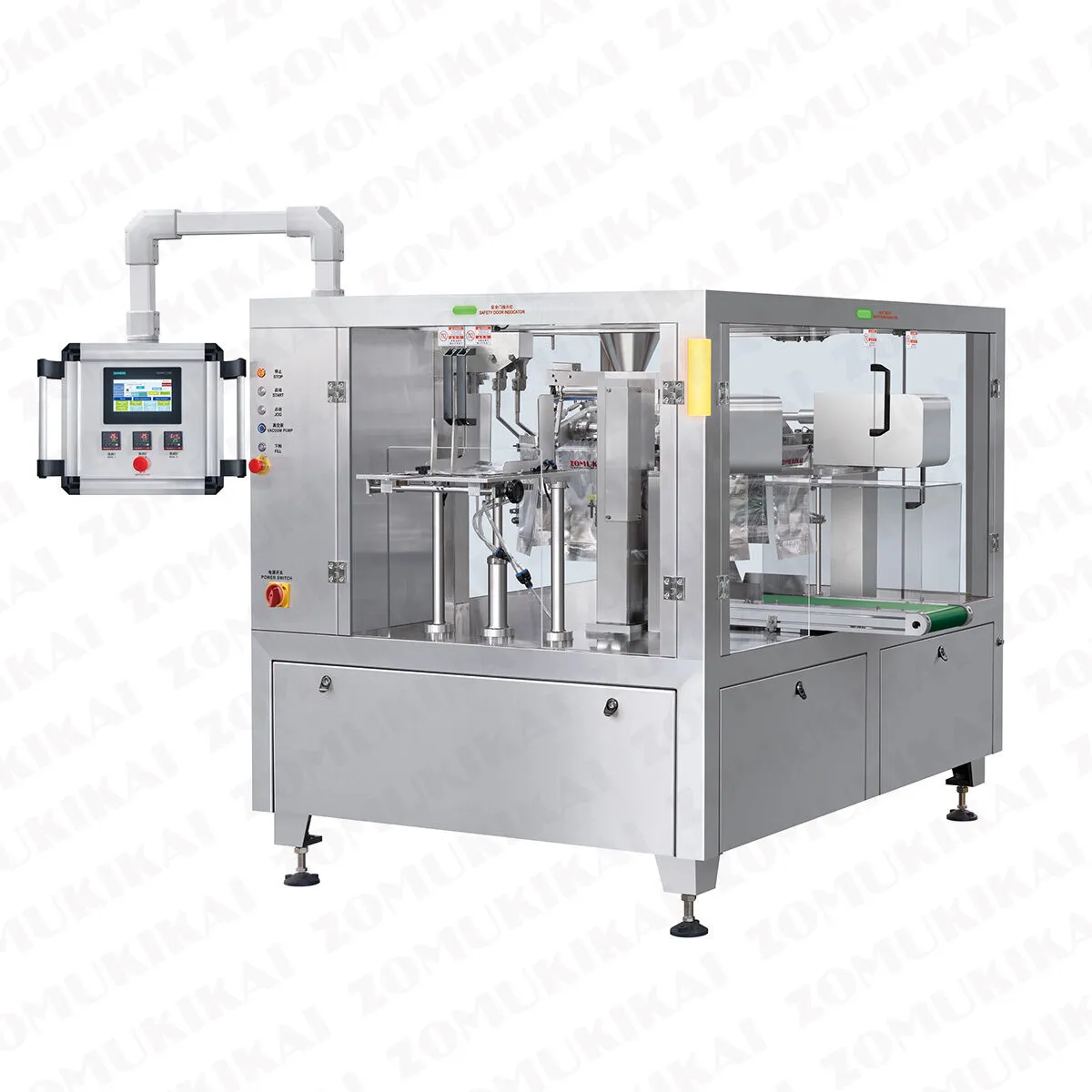
How a ZP Premade Pouch Machine Is Selected
All ZP premade pouch machines share the same rotary platform, control system and optional functions. What separates one model from another is the pouch width and length it accepts and the speed range that follows from the pouch size. Everything else is configured per project: the dosing equipment is matched to the product (granules, powder, liquid or a custom format), the stations are arranged for the pouch type and extras such as zipper closing, gas flushing or scoop insertion, and the line layout is drawn to fit the customer's plant space.
Selection therefore follows four steps: pouch size → model, product → dosing system, special requirements → station layout, plant space → layout drawing.
ZP Model Comparison
| Model | Type | Stations | Pouch width (mm) | Pouch length (mm) | Fill range (g) | Speed (pouches/min) | Power (kW) |
|---|---|---|---|---|---|---|---|
| ZP-8R120D | Dual lane premade pouch packaging machine | 8 × 2 lanes | 80–170 | 100–400 | 10–500 | 20–80 | 4.3 |
| ZP-8R200 | Rotary premade pouch packaging machine | 8 | 80–200 | 100–400 | 10–1000 | 10–60 | 3.2 |
| ZP-8R180M | Quad seal bag machine | 8 | 80–180 | 100–400 | 10–1000 | 10–45 | 3.2 |
| ZP-10R200 | Bagging machine, 10 stations | 10 | 100–200 | 100–400 | 10–1000 | 10–80 | 3.6 |
| ZP-8R260 | Automatic doypack packaging machine | 8 | 130–260 | 100–400 | 10–1500 | 10–50 | 3.2 |
| ZP-8R300 | Large doypack machine | 8 | 190–300 | 100–400 | 10–2000 | 10–40 | 3.6 |
| ZP-8R360 | Automatic pouch filling machine | 8 | 260–360 | 100–450 | 10–2500 | 10–25 | 3.8 |
| ZP-8R400 | Automatic rotary packing machine | 8 | 300–400 | 100–500 | 10–3000 | 10–25 | 4 |
Common to all models: air consumption 0.6 m³/min, power supply built to the customer's local voltage and frequency, and pouch types including flat pouches, stand-up pouches, zipper pouches, spout pouches and shaped pouches. The ZP-8R120D runs two lanes on an 8-station turret, so two pouches are handled per cycle; its speed is the combined output of both lanes.
Step 1: Choose the Model by Pouch Width and Length
- Up to 170 mm wide, high output: ZP-8R120D dual lane, up to 80 pouches/min combined, fills 10–500 g.
- 80–200 mm wide: ZP-8R200 (the most common model, 10–60 pouches/min), or the 10-station ZP-10R200 (100–200 mm wide, 10–80 pouches/min) when several functions must be combined on the stations.
- Quad seal and flat bottom bags up to 180 mm wide: ZP-8R180M.
- 130–260 mm wide, fills up to 1500 g: ZP-8R260.
- 190–300 mm wide, fills up to 2000 g: ZP-8R300.
- 260–360 mm wide, fills up to 2500 g: ZP-8R360.
- 300–400 mm wide, fills up to 3000 g: ZP-8R400.
Where two models overlap, the narrower model is normally the faster one. The speed ranges in the table are machine ranges: the rate reached on a project depends on the product, the fill weight and the dosing system. As an example from a nuts quotation on the 8-station platform, the committed speed was 20 pouches/min at 1 kg, more than 25 pouches/min at 500 g and more than 30 pouches/min at 300 g.
Step 2: Match the Dosing System to the Product
| Product | Dosing system | Key data from our quotations |
|---|---|---|
| Granules (pet food, nuts, snacks, frozen food) | Multihead weigher on a working platform, fed by a Z-type bucket elevator | ZM-MW range: 10, 14, 20 and 32-head models, weighing ranges 5–250 g to 20–1500 g, up to 130 packs/min, 1.6 L or 2.5 L buckets |
| Powders (milk powder, protein, coffee, detergent, seasoning) | Servo auger filler fed by an auger conveyor | ZM-AF: 10–2000 g; accuracy ±2% below 100 g, ±1% at 100–500 g, ±0.5% above 500 g; 50 L split hopper |
| Liquids and pastes (beverages, sauces, detergents) | Liquid filling system, or the paste mixing filling machine for pastes | Piston filling with an anti-drip filling head is used for beverages; gas flushing can follow on the next station |
| Custom | Counting, inner pouch insertion or a combined dosing set | Defined with our engineers after a test with your product and pouches |
For powders, a dust removal station and a vacuum dust collector keep the seal area clean; after discharge, a checkweigher and a metal detector can be added to the line.
Step 3: Arrange the Stations for Your Pouch and Extras
Each of the 8 stations can carry two functions. These are four station layouts taken from recent quotations:
| Station | Liquid beverage, zipper stand-up pouch | Dog food (granules) | Powder with desiccant and scoop | Nuts, zipper pouch |
|---|---|---|---|---|
| S1 | Vertical pouch feeding | Pouch feeding | Pouch feeding | Pouch feeding |
| S2 | Date coding (tape) + zipper opening | Ribbon date coding + zipper opening | Ribbon date coding + zipper opening | TTO coding + zipper opening |
| S3 | Pouch-top opening + pouch-bottom opening | Pouch-top opening + pouch-bottom opening | Pouch-top opening + pouch-bottom opening | Pouch-top opening + pouch-bottom opening |
| S4 | Filling | Filling + pouch-bottom vibration + hopper vibration | Filling + pouch-bottom vibration | Filling + pouch-bottom vibration |
| S5 | Filling + gas flushing | Pouch-bottom vibration | Desiccant + scoop | Scoop + pouch-bottom vibration |
| S6 | Reserve + zipper closing | Reserve | Dust removal | Dust removal |
| S7 | Sealing | Sealing + dust removal | Sealing | Sealing + gas flushing |
| S8 | Forming + discharging | Forming + discharging | Forming + discharging | Forming + discharging |
Related application pages: beverage pouches, dog food, powder with scoop and nuts.
Scoop and Desiccant Insertion for Powder Pouches
Placing a measuring scoop in each pouch of milk powder, protein powder or supplements is one of the most requested options this year. A scoop feeder sorts the scoops in a silent vibratory bowl, turns them to the same orientation along a spiral track, rejects inverted or overlapping scoops and releases one scoop into each pouch after the powder dose. The feed rate is set by frequency control to match the machine speed; the cabinet is 304 stainless steel (750 W, 1P 220 V).
When a desiccant sachet is also needed, a desiccant feeder cuts and drops one sachet per pouch (up to 200 sachets/min, with pouch-length self-check, anti-cut protection, automatic cutter alignment and a material shortage alarm). In the powder layout above, scoop and desiccant share station 5 directly after filling, and station 6 removes dust before sealing. More detail: automatic scoop insertion in powder packaging.
Step 4: Plant Space and Line Layout
We draw the layout from your plant space before the configuration is fixed. To prepare it we need:
- Your product (or a sample), the target fill weight and the required output
- Your premade pouches: pouch samples, or the pouch type and dimensions
- Floor dimensions, ceiling height and the position of doors and columns
- Upstream and downstream equipment the line must connect to
- Local power supply (voltage, frequency, phases)
A typical granule line runs from a Z-type bucket elevator to a multihead weigher on its working platform, the ZP machine, a finished-pouch conveyor, and optionally a checkweigher and metal detector. A powder line replaces the weigher with an auger conveyor and auger filler.
Standard and High-End Configuration
Standard on every machine: pouch magazine, open-pouch inspection and pouch detection (no pouch or pouch not opened: no filling, no sealing), ribbon date coding, double heat sealing and frequency-controlled speed. The high-end version adds a touch screen on a multi-angle display arm, automatic pouch width adjustment, safety doors with indicator lights, a run indicator, one-key start, aviation-plug signal and power connections, and a finished-pouch belt conveyor with safety cover. Main components: Siemens PLC and touch screen; Schneider inverter, breakers, contactors, relays, switching power supply and emergency stop; Omron phase sequence detection and encoder; Festo cylinders and solenoid valves; Orion vacuum pump. The base frame is carbon steel fully clad in SUS304 stainless steel; the upper working section is SUS304 or aluminium, and the hopper is available in SUS316.
Options include zipper opening and closing, gas or nitrogen flushing, TTO date coding, dust removal, scoop and desiccant feeding, and a centralized lubrication device.
Testing, Acceptance and After-Sales Service
- Pouch test: send your pouches for testing; if shipping is too costly, we source equivalent pouches locally.
- Acceptance: factory acceptance test (FAT) in Wenzhou; site acceptance (SAT) by agreement.
- Warranty: 12 months from acceptance. Failures from defective materials, manufacturing or design are repaired and the parts replaced free of charge.
- Support: remote support by video call, phone and email first; engineers on site when a fault cannot be solved remotely.
- Training: on-site training for operators and maintenance technicians during commissioning, or online training.
- Spare parts: original spare parts after the warranty; we recommend keeping a set of critical spare parts on site.
- After the warranty: lifelong technical consultation, spare parts supply and paid on-site service.
- Lead time: typically 30–45 working days after the deposit, depending on the configuration.
Send us your product, pouch and plant information through the contact page and our engineers will reply with a model, station layout and layout drawing.
Planning a line for your product? Send us the product, pouch size and target output. Talk to our engineers →
FAQ
The pouch width decides first. A 1 kg pouch that is 130–260 mm wide normally runs on the ZP-8R260 (10–1500 g); if it is up to 200 mm wide, the ZP-8R200 or ZP-10R200 also cover 10–1000 g. Wider 1 kg pouches move to the ZP-8R300 (190–300 mm).
The 10-station ZP-10R200 has two more stations for combining functions such as zipper opening and closing, gas flushing, dust removal or scoop insertion. The ZP-10R200 also reaches up to 80 pouches/min against 60 on the ZP-8R200.
When the pouch is up to 170 mm wide and the output must be higher than a single lane can reach: the two lanes give up to 80 pouches/min combined, with fills from 10 to 500 g.
Yes, within the width and length range of the model. Pouch width is adjusted through the clamps; the high-end version adjusts it automatically from the touch screen.
Yes. A vibratory bowl scoop feeder and a desiccant feeder work on the station after filling, and a dust removal station follows before sealing.
The warranty is 12 months from acceptance. Lead time is typically 30–45 working days after the deposit, depending on the configuration.