How to Evaluate a Packaging Machine Manufacturer in China: A Buyer's Checklist
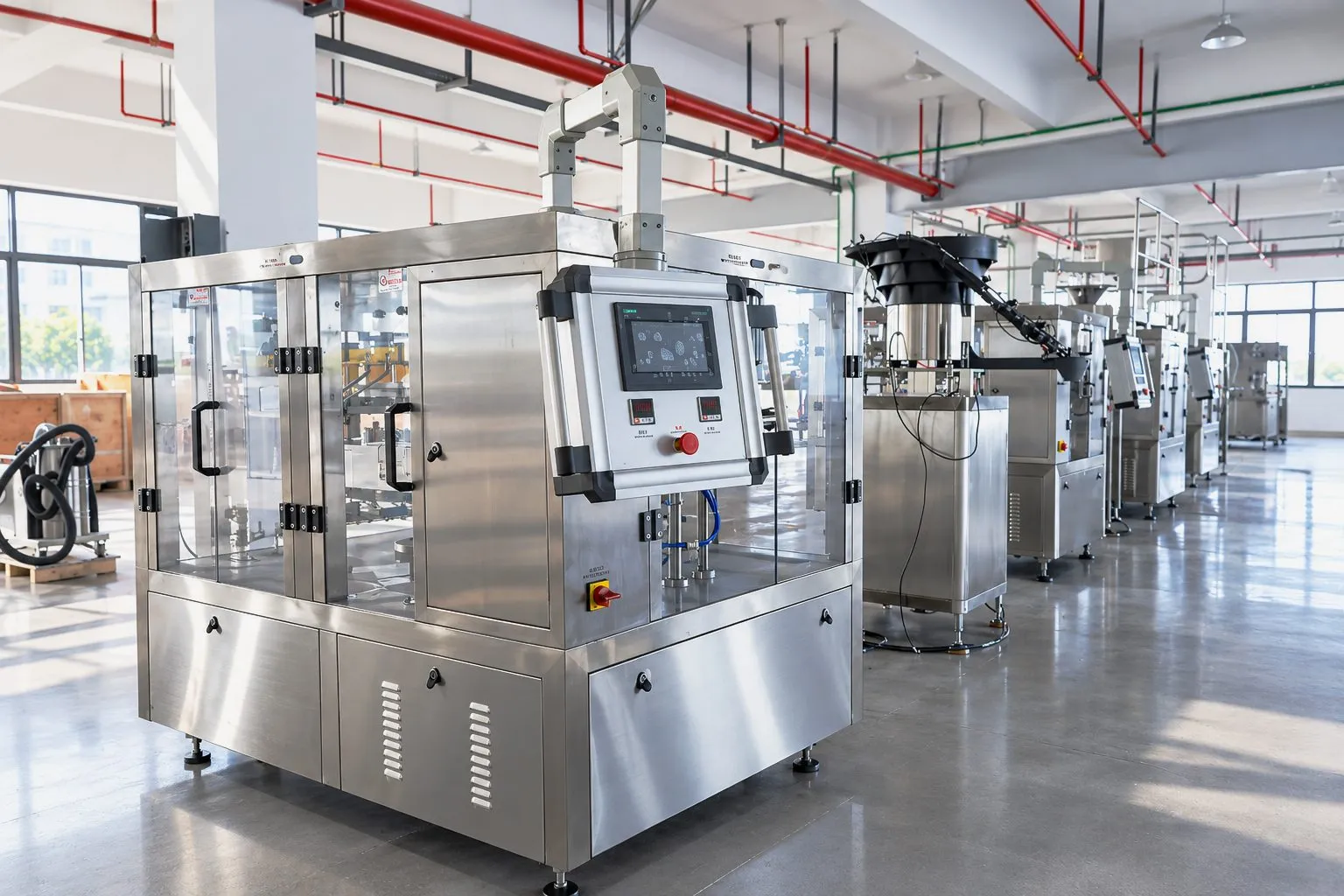
1. Engineering Capability: Design or Assembly?
Many suppliers in China assemble frames and mechanical parts bought from third-party vendors. A manufacturer with real engineering capability answers mechanical questions without referring to a third party.
- Ask for mechanical drawings: request a 2D layout and a 3D model of the main frame. A manufacturer has these on file; an assembler often supplies a generic CAD block from a supplier catalog.
- Ask about servo sizing: ask them to justify the torque rating of the main carousel servo motor for the speed you need. If they cannot explain the load calculation, they are likely copying a standard design without understanding its limits.
- Customization capability: ask for a modification, such as adding a powder deduster or changing the pouch format. A manufacturer can modify the design in-house; an assembler will decline or ask you to buy a different model.
For premade pouch equipment, the engineering conversation should also cover how the dosing station is matched to your product: a multihead weigher for granules, an auger filler for powders, a liquid filling system for liquids. A supplier who cannot explain this match is not engineering the line for your product.
2. Component Traceability: What Is Inside the Cabinet?
Electrical and pneumatic components determine uptime. A machine with domestic relays and uncertified cylinders will fail more often than one built with standard international brands.
| Component | What to Look For | Red Flag |
|---|---|---|
| PLC & Touch Screen | Siemens, Schneider, Omron | Unbranded or domestic PLCs with no software support |
| Pneumatics | Festo, SMC, AirTAC | Unbranded cylinders with no pressure ratings |
| Sensors | SICK, Omron, Keyence | Generic optical sensors with high failure rates |
| Servo Motors | Yaskawa, Delta, Panasonic | Stepper motors disguised as servo systems |
Always request a BOM (Bill of Materials) with brand names and model numbers. A manufacturer confident in their supply chain provides this without hesitation. The rotary premade pouch packaging machine page shows how a full component list is presented for one machine family.
3. Factory Audit: What Does the Floor Actually Look Like?
A video call or a site visit should focus on the production process, not just the showroom.
- Machining equipment: look for CNC machines, lathes and milling equipment. If they only have assembly stations, they are a trading company.
- Quality control station: is there a dedicated area for machine testing before shipment? A serious factory runs each machine with actual material before it leaves.
- Component inventory: look at the warehouse. If they stock common wear parts such as sealing jaws and vacuum cups for their own production, they can also ship them to you quickly for maintenance.
Ask how the factory acceptance test is run. At ZOMUKIKAI, a factory acceptance test (FAT) is carried out at the factory, and on-site acceptance can be arranged by agreement. Customers who attend acceptance at the factory are trained on the machine.
4. After-Sales Response and Technical Support
The first months after delivery are the make-or-break period. A supplier's after-sales capability can be evaluated before the contract is signed.
- Manual quality: request the operation and maintenance manual. If it is a poorly translated short PDF, their technical support will be just as weak. A good manual includes wiring diagrams, a troubleshooting tree and a maintenance schedule.
- Remote support: ask whether the HMI supports remote access, for example through a 4G router or gateway. A manufacturer that can log in remotely to adjust parameters saves days of downtime.
- Spare parts: ask how fast they can ship a replacement servo driver or sealing jaw, and whether common wear parts are kept in stock.
- Warranty and delivery terms: confirm the warranty period and delivery schedule in writing. ZOMUKIKAI states a 12-month warranty from acceptance and delivery typically 30–45 working days after the deposit; compare these terms across suppliers rather than assuming them.
5. Test With Your Own Product and Pouches
Specifications on paper do not prove that a machine will run your material. Send your own pouches for testing; if shipping the pouches or product is too costly, ask the supplier to source equivalent pouches locally for the test. A manufacturer who prepares the layout drawing and machine configuration from your product, pouch and site information is working from your data, not from a catalog.
For the machine side of the evaluation, start with the premade pouch packing machine range and compare the configuration against your pouch formats and product.
Planning a line for your product? Send us the product, pouch size and target output. Talk to our engineers →
FAQ
A manufacturer will have CNC machines, lathes and milling equipment in-house and can provide mechanical design drawings; a trading company typically has only assembly lines or a showroom, so ask for drawings and a video tour of the machining floor.
The BOM lists the brand and model of key components such as PLCs, servo motors and pneumatics, and it determines the machine's reliability; a supplier that refuses to provide a BOM is likely using low-quality or uncertified parts.
Spare parts lead time depends on the part and the supplier's stock policy, so ask specifically about common wear parts such as sealing jaws and vacuum cups and confirm the shipping method in writing before the order.