Automatic Scoop Insertion in Powder Pouch Packaging: How It Works
Why the scoop is a handling problem, not a filling problem
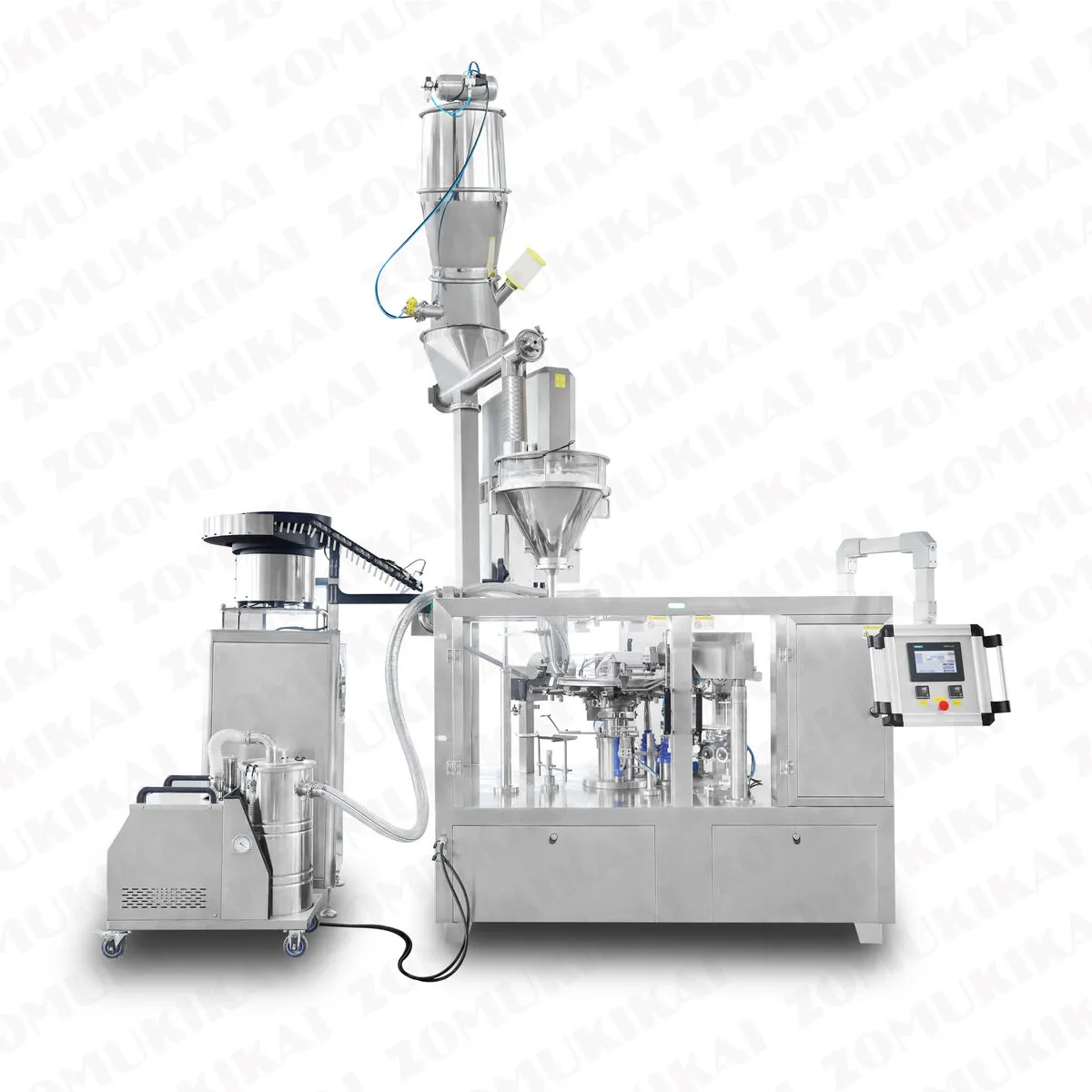
Powder dosing is a metering task: an auger filler delivers a target weight into an open pouch. The scoop is a rigid object that must arrive in the same pouch in a defined orientation, without touching the seal area and without colliding with the powder stream. On a rotary premade pouch machine the scoop is released at the filling station itself, so the scoop feeder and the auger filler share one index window. That shared window is where most of the engineering effort goes.
Doing this by hand works at low output, but placement varies between operators and a missed scoop is usually only discovered by the customer. Automating it only pays off when the feeder, the orientation track and the machine timing are specified together.
The scoop feeding cycle, step by step
A vibratory scoop feeder is a sequence of mechanical actions that must all finish before the pouch indexes on:
| Step | What happens | Why it matters |
|---|---|---|
| Bulk loading | Scoops are loaded into the feeder hopper | Nested or stuck scoops at the inlet cause feed jams downstream |
| Vibratory transport | The bowl or tray vibrates and moves scoops forward in a single layer | Vibration setting controls feed rate and how well scoops separate |
| Orientation | Track geometry aligns each scoop into a consistent position | A scoop that is not aligned must be rejected before it reaches the pouch |
| Release | One scoop is released above the open pouch after the powder dose | Release timing must sit inside the pouch opening window |
| Verification | A sensor confirms the scoop has entered the pouch | Catches a missed scoop before the pouch reaches sealing |
Because the scoop drops at the filling station, the release has to happen after the auger has finished dosing but before the pouch moves to the reserve station. If the feeder runs continuously while the carousel pauses, scoops pile up at the release point; the feeder should be indexed to the carousel rather than run at a fixed speed.
Vibratory bowl feeder and tray feeder compared
- Vibratory bowl feeder — scoops travel around a circular bowl on a spiral track, and the track geometry sets the orientation. It handles higher feed rates and scoops with a pronounced handle, but it is louder, harder to clean and needs new tooling when the scoop shape changes.
- Vibratory tray feeder — scoops travel along a linear tray driven by an electromagnetic vibrator. It is simpler, quieter and easier to clean, and suits flat or symmetric scoops. Tray length sets how many scoops are in transit at any moment.
For a standard measuring scoop in a protein powder pouch, the choice comes down to scoop shape and line speed, and it is confirmed on a sample of the actual scoop, not from a drawing.
Timing: where scoop insertion fails
Most scoop problems on a running line are timing problems, not mechanical ones. Three relationships decide whether the system stays clean:
- Feeder output against pouch index time — exactly one scoop must be released per pouch cycle, indexed to the carousel.
- Release against the pouch opening window — the scoop must drop while the pouch mouth is held open at the filling station. Early release leaves the scoop waiting above a closed pouch; late release drops it against a closing mouth.
- Scoop drop against powder dose — the scoop lands on top of the freshly dosed powder, so the auger must be clear of the pouch mouth before the scoop falls.
A system that runs clean through the first production week is normally timed correctly. Repeated missed scoops or jams in that week point to a timing mismatch that adjustment alone will not settle.
Scoop properties that affect the feeder
| Scoop property | Effect on feeding | What to specify |
|---|---|---|
| Material and static | Plastic scoops build static and cling to tracks | Anti-static treatment on the track, or ionizing bars at the release point |
| Shape and symmetry | Asymmetric scoops with a handle need orientation tooling | Bowl feeder with a shaped track, or a tray feeder with an orienting gate |
| Size against pouch mouth | The scoop must pass the open mouth without forcing | Pouch opening width checked against the scoop width during the pouch test |
| Nesting tendency | Stacked scoops stick together and feed in pairs | A separation stage ahead of the orienting track |
The most common specification error is configuring a feeder for a scoop that was never run through it. A scoop that looks ordinary can have a handle angle or a surface finish that jams at production speed, so a scoop sample belongs with the pouch sample at the test stage.
Pouch and product details to send with the enquiry
ZOMUKIKAI builds the layout drawing and machine configuration from the customer's own product, pouches and site information. For a powder line with scoop insertion, that means the powder and its bulk density, the premade pouch including zipper or shaped features, and the scoop itself. Customers send their own pouches for testing; where shipping pouches or product is too costly, equivalent pouches are sourced locally for the test. The full standard configuration, main components and project process are set out on the rotary premade pouch packaging machine page, and the powder version with scoop insertion is described on the protein powder packaging machine page.
Video

Planning a line for your product? Send us the product, pouch size and target output. Talk to our engineers →
FAQ
Automatic scoop insertion works at the filling station: a vibratory scoop feeder sorts the scoops and releases one at a time, and after the auger has dosed the powder into the open pouch, one scoop drops into that same pouch, which then indexes on toward sealing.
A vibratory tray feeder moves scoops along a linear tray and is simpler, quieter and easier to clean, while a bowl feeder moves scoops around a circular bowl on a spiral track, handles higher feed rates and more complex scoop shapes, and needs tooling changes when the scoop design changes.
The scoop is inserted after the powder has been dosed, so it comes to rest on top of the powder in the pouch. This keeps the auger clear of the scoop and avoids the scoop sitting under a falling powder stream.
Scoop jams usually come from static cling on plastic scoops, nested scoops feeding in pairs, or a feeder running at a fixed speed while the pouch carousel pauses. Anti-static treatment, a separation stage and indexing the feeder to the carousel address most of these causes.
A scoop feeder can be adjusted for small changes in scoop volume by altering the track width, but a significantly different scoop dimension, shape or handle design may require new orienting tooling. The scoop sample is checked on the feeder before the configuration is fixed.